Overview
Sankalp Sinha was a product designer. Now he builds products alone, and his current one is NextDoor.Company, a map of startups hiring near you. On 11 October he spoke at The GTM School about how he made that switch, how he picks what to build, and how a designer with no marketing background learned to get users. These are my notes from the session, written up from my handwritten pages and the notes I typed on my phone, so any mistakes are mine.
Speaker: Sankalp Sinha, builder of NextDoor.Company
Event: From Product Designer to Solopreneur: Building, Growing & Marketing NextDoor.Company (event page)
Series: The GTM School, a community initiative by AI Learn Circle and Women in Product Marketing, with Paytm as community partner
Date and venue: 11 October 2026, Bellandur, Bengaluru
Build what you feel the pain for, charge from day one, and talk to every user yourself. People will copy your product, but they pick the one that cares about them.
A session shaped by the room
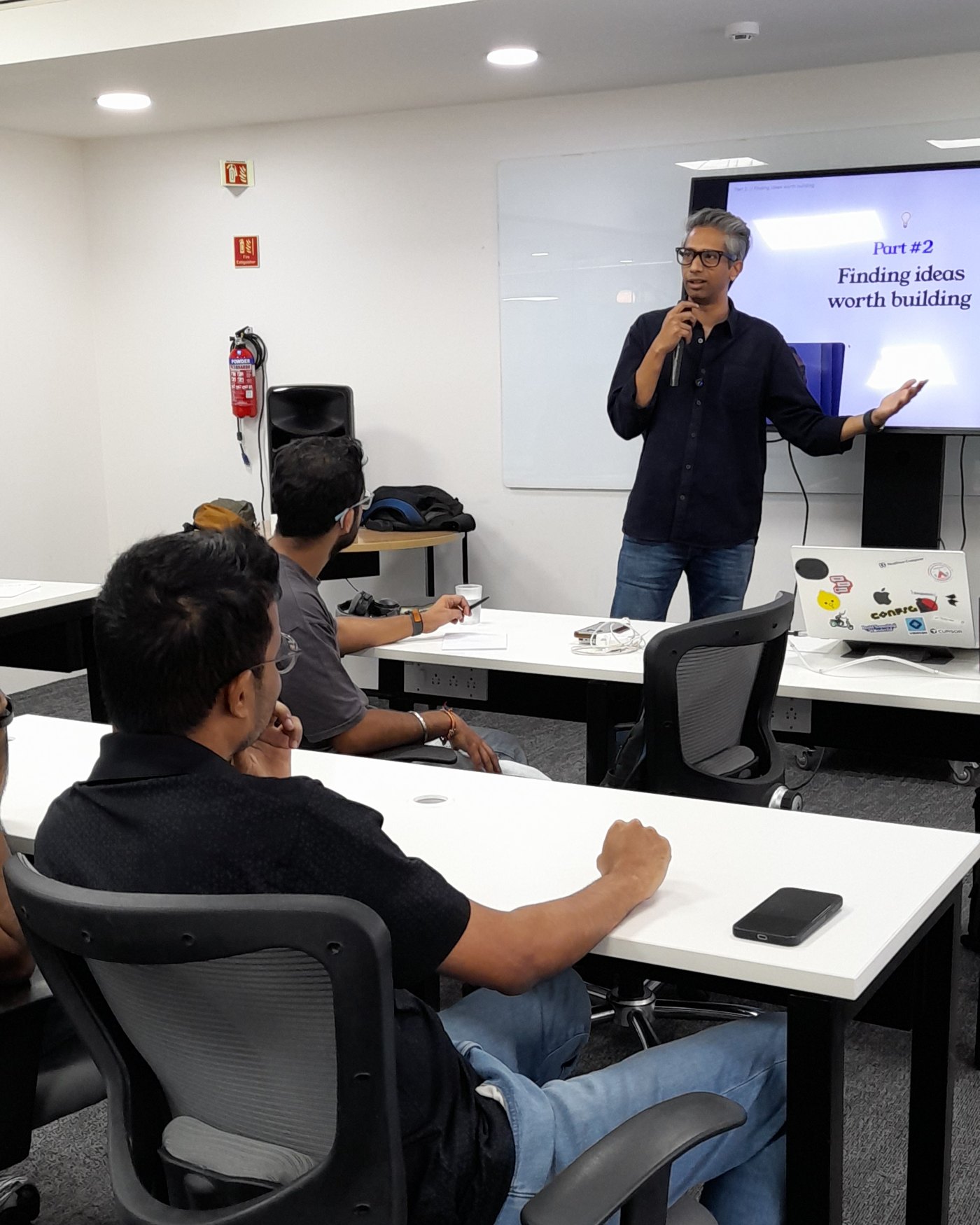
What I liked most happened before the talk started. Sankalp walked around and talked to people. Who is in the room? What do they do? What do they need, and what are they expecting from this session? What kind of help are they looking for? Only after that did he begin. He came to us and talked to us like a friend, and it felt very nice.
It was not a typical session where a speaker goes through slides. He watched what the room needed and adjusted. A lot of questions were coming in early, so he stopped and asked whether those questions were helping everyone. We all said yes, and from then on the session was mostly questions and answers, with his slides as the backbone.
At most talks the speaker covers what they came to say, and audience questions get squeezed into the last five minutes or skipped. Here we could ask anything, and nobody held back. People asked "is this a stupid question?" and got a real answer anyway. It was free, frank and friendly. By the end everyone's questions had been answered and everyone left happy.
Because of that format, my notes are not in slide order. Someone would ask a question halfway through a section, he would answer it, and I wrote the answer down right there. Below, I have grouped everything under the slide it belongs to, and collected the off-topic answers at the end.
What I took away
Productize your own behavior. Sankalp used to write down three goals every day, so he built an app for it. He wanted to find jobs near him, so he built NextDoor.Company. He also gave a bigger example: we have always asked the house help to bring something from the shop, and Swiggy and Zomato turned that habit into apps.
Build for a pain you feel yourself. Don't copy what is already in the market or what seems to be working for someone else. You need your own care for the problem, and your own pain, to keep solving it.
User experience matters more than the building and the engineering.
Be original and show care for your users. Someone will always copy what you build, and users choose you only when they can see that you care and they trust you.
NextDoor.Company in brief
NextDoor.Company is bootstrapped and profitable. It isn't a recurring monthly SaaS subscription: you pay once for a fixed period of access, such as one month, three months or a year.
It wasn't his first product. He built several apps before it, and those are what trained his user focus and his habit of designing things people find easy to use.
Part 1: From product designer to solopreneur
User focus is a muscle
Build lots of projects without expecting them to work. Each one trains you.
Sankalp's view is that engineers tend not to be user focused, and that user focus is a muscle you have to build first. Designers think about the whole experience a person has with the product, and that is the advantage a designer brings to building alone.
His loop:
- Design.
- Show it to friends.
- Gather feedback.
- Replan, and design again.
Go talk to people, ask about their problems, and try to build something that solves them.
Before you quit your job
Someone asked what you need before making the jump. His answer: the only prerequisite is money. Have 6 to 12 months of expenses saved, or more.
And if you do this, do it for fun. While you are having fun, you figure the rest out on the way.
Making a product people want to use
People pay for software to get convenience.
Users won't tell you what's wrong. You have to infer it from their behavior. You also can't force anyone to use your product; use should happen on its own. The app should feel right. When you collect feedback, the question to answer is whether the app does what it says it does.
You need your own insight into which features to build and which to skip. You learn UX from your users: look at what competitors are not doing and how it could be done better for them. Products should feel fun. Your landing page should tick off every pain your user has.
For product design, he recommended looking at Jason Fried and Basecamp. For UI components, he recommended shadcn.
When you're a designer and the architecture worries you
A question came up about technical architecture for people who don't come from engineering. His hack has two steps. First, check your architecture with developer friends. Second, ask AI to draw a diagram that explains the architecture to you.
Part 2: Finding ideas worth building
Make it for yourself first
Build what you would use yourself. Don't copy an idea just because you see traction, because you won't connect with or care about the problem.
His process:
- Notice a problem.
- Explore it.
- Build it for yourself first.
- If you are still using it after a month, turn it into software for others.
Build for the pain you feel, and understand the problem well enough that you can infer what users need. If you have nothing you need to build, it's fine to take a job and learn on the job. You must have the pain or the problem to build something. Otherwise, don't build.
Productize existing behavior
Look at what you already do, and watch what other people do. His three goals a day became a to-do app. People asking house help to buy groceries became Swiggy. Building is easy now, so find a behavior like that, build the product, publish it or put up a waitlist, and see how it performs.
The apps he built
In order: a first app, then an AI-first applicant tracking system, then job discovery, then paid directories. The job discovery idea came from friends who couldn't find jobs because there was no good way to discover them. He faced that problem first hand, and it led to NextDoor.Company.
One thing at a time
Figure things out one by one. Build first, then work on go-to-market. A simple test for GTM: can I get one user by shitposting every day?
What if you don't have any following? You still have to find your channels. He mentioned Reddit and Instagram trial reels.
Part 3: Learning GTM as a designer
Rule 1: Build in public
Marketing is letting people know what you have.
Shitpost on all your socials and cross-post everywhere. Over time you learn what works where. It takes time, but it works. Do it for the sake of doing it, and stay consistent for a year or more. Building in public is what builds trust.
Rule 2: Speak your ICP's language
Nail down your ideal customer profile: who exactly you are building for. Find out where they hang out. Say out loud the things they keep hush-hush. Put your gut out on social media and be yourself.
Schedule posts for when your ICP is awake. He mentioned Buffer, SuperX and Typefully.
Spend a few hours every day, spread through the day. Keep posting, but don't obsess. If you are having fun building, pull yourself out every two hours to think and post.
Don't over-tune what you post. You need a personality to grow online, so post whatever comes into your head.
Do all of this for fun, without expectations. If you do it for the outcome, you won't make it. Learn it for fun and build the muscle for building in public, Instagram marketing and the rest.
Rule 3: Show traction
- Show people interacting with the app.
- Mention improvements to the app and to its data.
- Post every sale you make.
Rule 4: Talk to users
Sankalp is in touch with more than 1,600 of his users. You talk to them to learn.
Talk to people when they sign up. Ask why they decided to use it, how they feel about it, and to tell you honestly whether it's good or bad. He introduces himself as the owner and thanks them for buying.
Share what you learn on social media. Ask for testimonials. Make people believe you are a real person and not AI, and genuinely care.
Building is the easy part now. The harder part is sitting with people and asking questions. One question he recommended, which I marked as a great hack in my notes: "What is the last product you used and paid for?" (I wrote up how to run these conversations in a practical guide to problem discovery.)
Get your first 100 customers
Talk to every user, yourself. The more users you talk to, the clearer the direction gets. Show traction, and show it often.
Charge from day one
Once you take money, you are building for your users, not for yourself. Know the difference.
You charge for the human side of the product and for making users comfortable using your app.
Free products don't work. Charge from day one, because the purpose of a business is to sustain itself. Build with a payment button. Don't offer a trial: you either get the money or you don't, but payment should be the first thing.
One of his products went from a hackathon to an MVP to a waitlist, and he got his first payment three days later. Keep the price very low for your first 100 users.
Waitlists or pre-orders?
The longest waitlist he runs now is 48 hours, and at the moment he does pre-orders instead. A waitlist is fine if you want to test the waters, but he doesn't use them anymore. He builds the product, releases it and puts payment in front of it. Waitlists sometimes get taken advantage of, for example by people who copy the idea.
Other answers from this part
- Hire an intern for specific work if you need to, though AI can now handle a lot of that.
- He picks simple product names that say what the product does.
- If something feels undoable, sleep on it. Many times, if you need to.
- Going solo or building a startup is a personal choice. VC money comes with liabilities.
Part 4: Growing
Repeat what works, always
Find a format that works and keep honing it.
Find your hero channel
Post, and watch what goes viral.
Give a taste and users come back
Get people to engage with your reels. He uses a free lead-gen idea on Instagram: put out free resources that have real value, and if people want more, they sign up and pay. On NextDoor.Company that means showing five companies, and asking people to pay to see more.
Stick to your hero channel
Once you know what works, double down on that channel.
Part 5: Turning attention into trust
More content, more audience
Put yourself on the internet and say what you actually think. People find products through you. Be authentic and post everything.
Go meta and share your wins
Post your viral moments. Share every press feature. Cross-post your wins.
Product Hunt
A Product Hunt launch gives you a good domain rating (DR) and creates backlinks. Do it if you have zero users, and do it to get to 100 users.
His launch playbook:
- Get 100+ real users first.
- Get a hunter to post the launch on your behalf.
- Build an upvote list by hand: a spreadsheet of people who will upvote for you.
- Message all of them two days before. He sent 500+ messages to contacts.
- On launch day, spend 24 hours shamelessly pinging people. Track who you pinged, who voted and who's left.
- Being in the top 3 at hour four tends to stick.
Beware of scams that offer votes for money.
Questions beyond the slides
Care and story
Show care for your users. Set up a narrative or story for your product. Be original, and be yourself online, in your product and in your build-in-public journey.
What to read and who to follow
- Hooked by Nir Eyal
- Jason Fried of Basecamp
- Shreyas Doshi
- The growth.design website
Follow the classic experts in a field over whoever is hyped online this month. And study how copywriting works.
Dealing with loneliness
Someone asked about the loneliness of building alone. His answers:
- Come to communities like this one.
- Call your friends. He called this the best hack.
- Take help from people whenever you need it.
- Travel and meet your friends.
- Make good friends.
- Work from cafes. Lots of solo builders and startup people work from cafes; you just have to figure out which ones.
Clearing your head
Writing with pen and paper solves a lot of problems, or at least shows you the next action item.
If you overthink, your thoughts feel disorganized, you keep jumping between things and nothing feels certain: go to a cafe without your phone or laptop and write your thoughts in a diary. Do it regularly and consistently for six months.
Make time for recreation too. Have a hobby, go out with friends, watch movies. Entrepreneurship is hard, and you need these things.
Getting hired
- Write case studies of companies (their GTM and so on) and put them online. Someone will reach out and ask why you don't work for them.
- Act as the person you want to become. If you want to be a PM, do case studies and projects as a PM and put them online.
- Build something a company wants and send it to the founder or someone in management.
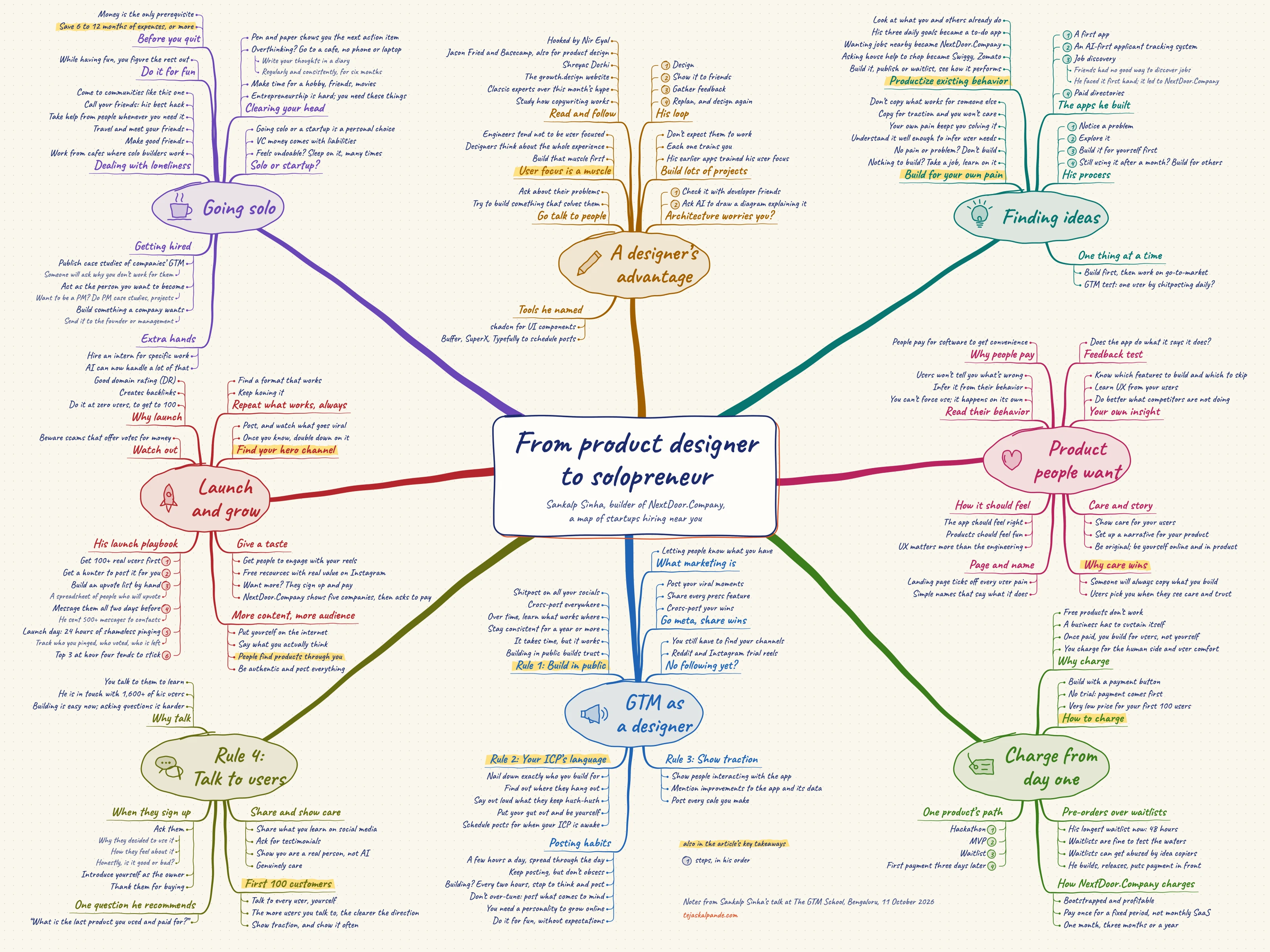
The talk on one page
Here is the whole session as one mind map. Highlighted items also appear in the key takeaways below. The text is small on a phone, so open the full-size map (PDF) and zoom in.
Key takeaways
- User focus is a muscle. Build it first.
- Save 6 to 12 months of expenses before you quit.
- Build what you feel the pain for. Make it for yourself, and if you still use it after a month, make it for others.
- Productize behavior that already exists.
- Charge from day one, with a payment button, and keep the price low for the first 100 users.
- Build in public in your ICP's language, for fun, for years.
- Talk to every user yourself until you have 100 customers.
- Find your hero channel and double down on it.
- People find products through you. Care is why they pick yours over a copy.
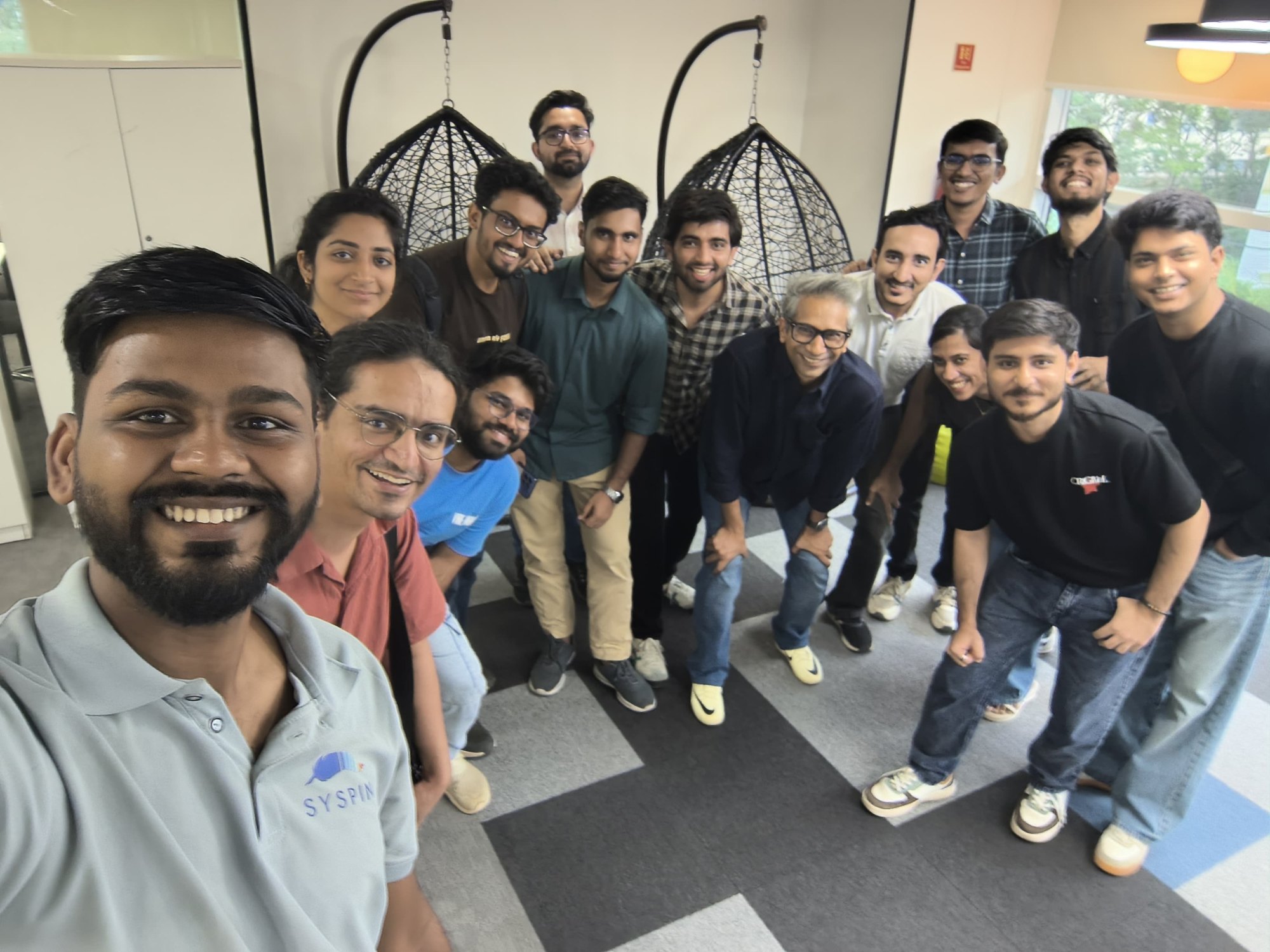
Thanks to Sankalp for a session where every question got answered, and to The GTM School, AI Learn Circle, Women in Product Marketing and Paytm for hosting.
Related: my notes from another GTM School session, with Pulkit Jain of Vedantu.